
You know the sound. It’s the rhythmic thump… thump… thump of footsteps from the apartment above, a sound that makes you flinch with every step. It’s the muffled but undeniable bassline from a neighbor's sound system vibrating through your walls. It’s the jarring slam of a door that seems to echo through the very bones of your house. This is the reality of modern living for many—a constant, involuntary awareness of the lives happening around us, invading our personal space and robbing us of peace.
To effectively combat this intrusion, you first have to understand the enemy. Unwanted noise comes in two primary forms:
Airborne Sound: This is sound that travels through the air. Think of conversations, a television playing, or a dog barking. The sound waves travel from the source, hit a surface like a wall or ceiling, and cause it to vibrate, which then reproduces the sound on the other side.
Structure-Borne Sound: This is the most frustrating and difficult type of noise to control. It is a vibration that travels directly through the solid materials of a building's structure—the wood studs, concrete slabs, and ceiling joists. This is the thump of a footstep, the rattle of a subwoofer, or the slam of a door.
Many people believe that stuffing their walls with insulation is the ultimate solution. While insulation is excellent for absorbing some airborne sound, it does almost nothing to stop the transfer of structure-borne vibrations. To stop that physical shaking, you need a different, more robust strategy: decoupling. This is the science of mechanically separating your walls and ceilings from the building’s frame. And the professional’s choice for achieving this separation is a system built around an unsung hero of the industry: the drywall furring hat channel from SoundAway. Learn more below, and get in touch today.
At first glance, a drywall furring hat channel (often just called a "hat channel") seems simple. It’s a rigid, hat-shaped channel cold-formed from steel. You’ve likely seen them on construction sites, and they don’t look like much. But it’s crucial to understand that a hat channel is not a standalone soundproofing solution. It can work in tandem with sound isolation clips. And, its power is not in the material itself, but in its role as the backbone of a "floating" wall or ceiling system. It is a critical component among a suite of soundproofing products designed to work in harmony.
When you hold a SoundAway hat channel, you’re holding a piece of precision-engineered steel designed for optimal acoustic performance.
Durable Material: Our channels are made from 25-gauge steel, providing the ideal balance of strength and resilience needed for decoupling.
Safety and Rigidity: The edges of the channel are hemmed, which not only makes them safer to handle and prevents cuts but also adds a significant degree of structural rigidity to the channel itself.
So, how does this simple piece of metal stop a powerful vibration in its tracks? The secret lies in how it’s used within a complete system. The best way to understand decoupling is to think of the suspension system in your car.
The road is the frame of your house, and the bumps, potholes, and rough patches are the sound vibrations from footsteps, music, and other impacts. Your car's springs and shocks act as isolators, absorbing the violent energy from the bumps so that you, the passenger inside the cabin, can enjoy a smooth, quiet ride.
The hat channel and isolation clip system work in precisely the same way for your room:
Isolation Clips are Key: The process begins with high-performance sound isolation clips, such as the industry-leading Kinetics IsoMax or RSIC-1 clips. These are not simple pieces of hardware; they are engineered isolators with rubber or neoprene components designed specifically to absorb and dissipate vibrational energy. These clips are attached directly to the wall studs or ceiling joists.
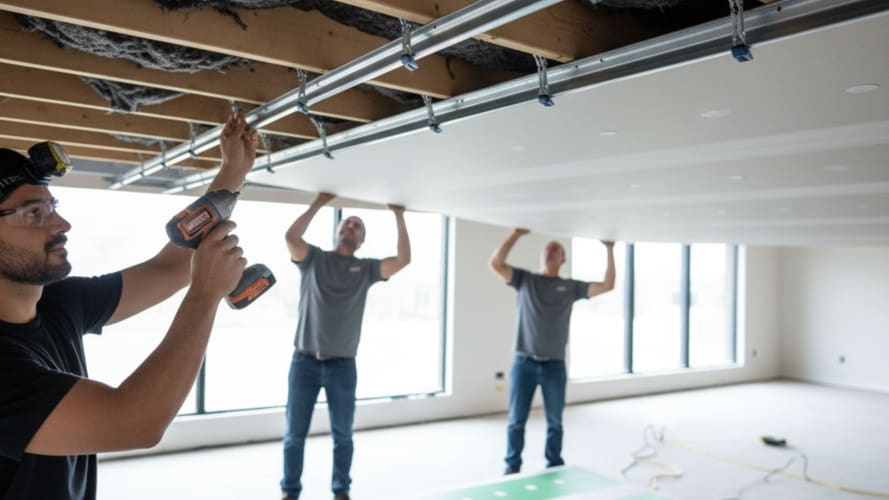
Hat Channels Snap In: Next, the 25-gauge furring hat channels are snapped firmly into these clips. This creates a brand-new, resilient frame for your drywall that "floats" about an inch away from the building’s actual structure, supported only by the flexible rubber feet of the clips.
Drywall is Attached: Finally, one or more layers of drywall (preferably heavy, 5/8" Type X) are screwed only to the furring channels. At no point should the drywall or the screws touch the original studs or joists. And, one should apply acoustical caulk around the perimeter of the drywall. The gap to be filled by the caulk should not exceed 1/4".
The result is a fully decoupled, "floating" wall or ceiling. Now, when structure-borne sound hits, its journey is interrupted. The vibration travels down the joist but is met by the rubber on the isolation clip. The vibration is effectively mitigated, and your room remains quiet. This system is one of the most effective soundproofing materials combinations on the market for fighting structure-borne noise.
Acoustical consultants and professional contractors rely on the clip and channel system for a reason: it delivers predictable, high-level performance. When implemented correctly, it can drastically increase a wall or ceiling's Sound Transmission Class (STC) and Impact Insulation Class (IIC) ratings.
The Importance of 25-Gauge Steel: It might seem counterintuitive, but a heavier, thicker gauge of steel would actually be less effective for the channel. The 25-gauge specification provides the right amount of resilience and flexibility. It's rigid enough to support multiple layers of drywall but not so stiff that it readily transmits vibrational energy through the system.
Eliminating the "Short Circuit": The single most critical installation rule is to ensure your drywall screws are the correct length. A screw that is too long will pass through the drywall, through the hat channel, and into a stud or joist behind it. This single point of contact creates a rigid bridge for sound and vibration, completely bypassing the isolation clips. This "short circuits" the entire system, rendering it acoustically ineffective. Always measure and use the proper screw length.
The versatility of the hat channel system makes it the ideal solution for a wide range of noise-control challenges.
Ceilings and Walls (The #1 Use Case): This is the undisputed champion for blocking impact noise like footfalls, running children, or dropped items from the floor above. It is effective in mitigating lower frequencies from transferring to adjacent rooms. Decoupling the ceiling is often the only way to find true peace in a lower-level apartment, condo, or basement.
Home Theaters & Recording Studios: Low-frequency bass is notoriously difficult to contain. A decoupled wall and ceiling system is essential for isolating these powerful sound waves, preventing them from disturbing the rest of the house and creating a truly immersive, professional-grade acoustic environment. Once the room is isolated, you can then focus on its internal acoustics by installing acoustic panels or custom acoustic paneling to control reflections and echoes.
Multi-Family Dwellings: For developers and residents of apartments, condos, and townhomes, this system drastically improves quality of life. Hat channels help in ceilings and more, creating true speech privacy between units, reducing disruptions, mitigating impact noise from tenants above, and making for happier tenants and homeowners. It’s a foundational step that goes far beyond simply adding basic sound-absorbing panels for home use between units.
Commercial Spaces: In the workplace, speech privacy is paramount. This system is perfect for building conference rooms where sensitive conversations won't be overheard, private offices that allow for focused work, and healthcare or therapy facilities where patient confidentiality is legally required. While commercial acoustic panels are great for reducing echo in a lobby, the clip and channel system provides the true sound blocking needed for privacy. The same goes for acoustic panels for walls in an open-plan office; they improve clarity but don't stop sound from traveling through the wall. And, clips and channels help to add mass and provide robust soundproofing to prevent loud machinery, typically associated with lower frequencies, from disrupting rooms utilized for quietness and focus.
Whether for a home or commercial setting, the principle remains the same. Once you have used the hat channel system to build a properly isolated room, you can then install a variety of sound absorbing panels to perfect the sound quality inside that room.
There is no magic bullet for soundproofing. Stopping airborne sound can be managed with mass and absorption, but stopping the relentless energy of structure-borne sound is impossible without decoupling. The furring hat channel and isolation clip system is the most reliable, space-efficient, and scientifically-proven method for achieving this crucial separation.
Choosing to build this system is more than just a home improvement project; it's an investment in your daily quality of life. It’s an investment in peace, in privacy, in focus, and in the long-term value of your property. By committing to a system that works, you are choosing to build it right so that you can finally build it quietly.
Ready to create your quiet space? Shop our Drywall Furring Hat Channel 20-Pack today and build the foundation for true sound isolation.
Have questions about your project? Contact the experts at SoundAway for personalized advice and a complete list of materials, including the essential Kinetics IsoMax and RSIC-1 isolation clips needed to complete your system.