
You’ve dedicated weeks, maybe even months, to your soundproofing project. You meticulously planned every detail, investing significant time and money into creating a sanctuary of quiet. You selected high-mass drywall, perhaps multiple layers. You filled the wall cavities with dense, high-performance insulation. You may have even taken the professional step of installing resilient clips and hat channels to decouple walls and ceilings. Finally, the work is done. You stand back, proud of the robust, solid construction, anticipating a profound silence. But as you listen closely, the frustrating reality sinks in. You can still hear the low, thumping bass from your neighbor's stereo, the faint but intelligible chatter from the adjacent office, the rhythmic thud of footsteps from the floor above. The noise is muffled, certainly, but it’s not gone. How can this be?
You have just encountered the hidden enemy of nearly every soundproofing project: the acoustic leak. The physics of sound are unforgiving. Sound energy, much like water, is relentlessly opportunistic. It will exploit any path of least resistance, seeping through the smallest, most imperceptible cracks and gaps in your construction. It will also travel as a vibration directly through the solid structure of your building. Think of sound as a car that is driving on the freeway with the windows fully up, compared to when a window is slightly rolled down.
The culprit is a combination of flanking noise and structural vibration—sound that bypasses your primary barrier by traveling around it or directly through it. Fortunately, the professional solution is not only surprisingly simple but also remarkably affordable. At SoundAway, we want to let you in on the secret that separates amateur results from professional-grade silence: Neoprene Isolation Gasket tape. This is the essential, final-step material that creates a complete acoustic seal to block airborne leaks while simultaneously damping the structural vibrations that other soundproofing materials can’t stop. It’s the missing link that perfects your project. Learn more below, and get in touch today.
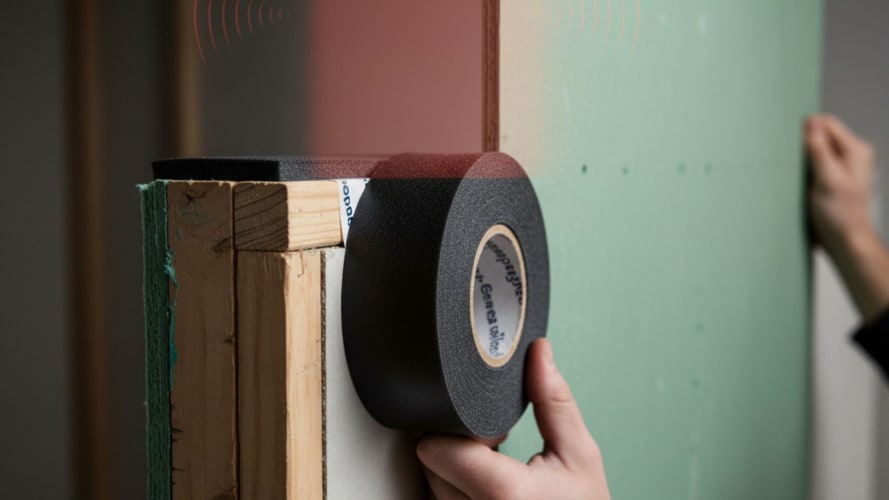
Before you can fully appreciate its profound impact, it’s essential to understand what this product truly is. At its core, our Neoprene Isolation Gasket is a high-density, closed-cell neoprene foam tape that comes with a strong, high-tack pressure-sensitive adhesive (PSA) on one side for a simple, permanent peel-and-stick application. It’s one of the most effective and often overlooked soundproofing products available, a true secret weapon in the professional’s arsenal, and an essential building block to maintain the integrity of a soundproofing assembly. Its effectiveness stems from the advanced material science behind its construction.
Let’s break down its key properties and what they mean for your project:
Closed-Cell Foam: The term "closed-cell" is critical. Imagine a microscopic view of the foam; you would see countless tiny, individual pockets of gas, each one sealed off from the next. This structure makes the material impermeable to air and water. Unlike open-cell foam (like a dish sponge), which can absorb moisture and act as a wick inside a wall cavity, closed-cell foam is a durable, water-resistant barrier. In the context of sound, this means it creates a true air seal. This distinction is vital: open-cell foams are used for absorption (like the foam inside acoustic panels), while closed-cell foams are used for isolation and blocking.
High-Density: Not all foams are created equal. Our gasket is a high-density material, which means it has exceptional "compression set resistance." In simple terms, this means it resists being crushed flat over time. Even under the immense and constant pressure of a multi-layer drywall assembly or a heavy subfloor, it maintains its structural integrity and its ability to cushion and seal for the life of your building. Cheaper, lower-density foams will compress into a hard, useless wafer within a few years, completely negating their acoustic benefits.
Pressure-Sensitive Adhesive (PSA): This isn't your average craft tape. We use an aggressive, high-tack acrylic adhesive engineered to create a permanent bond with common construction materials, including wood studs, steel framing, concrete, and drywall. For a successful application, the surface should be clean and dry. Once applied with firm pressure, the adhesive forms a lasting bond that won't peel or fail over time due to temperature changes or humidity.
This powerful combination of properties makes our Neoprene Isolation Gasket a critical dual-purpose product. Its two primary, interwoven functions are to (1) create a permanent, flexible, and truly airtight seal to block airborne sound leaks, and (2) act as a resilient vibration damper, or "gasket," between two hard surfaces to limit the transmission of structure-borne noise.
To grasp why a perfect seal is non-negotiable in high-performance soundproofing, you need to understand the concept of "flanking paths." A flanking path is an indirect, secondary route that sound takes to bypass your primary soundproofed barrier. You can build a wall with an incredibly high STC (Sound Transmission Class) rating, but if you leave a tiny gap at the floor or ceiling, sound will flank right around it, dramatically compromising the wall's real-world performance. The most common and significant flanking path in any room is its perimeter—the continuous connection point where your walls meet the floor, the ceiling, and each other.
This is where the gasket works its magic as an acoustic sealant. By applying the gasket tape to the full width of the top and bottom plates of your wall framing before the first layer of drywall goes up, you are proactively creating a resilient barrier. As you lift and screw the heavy drywall sheets into place, their weight uniformly compresses the foam gasket against the floor and ceiling. This action creates a permanent, airtight, and flexible seal that moves and breathes with your building. This simple barrier effectively plugs the gap that would otherwise exist, stopping airborne sound from leaking out from under your wall. This step is absolutely critical when you are building walls directly on a hard, reflective surface like a concrete subfloor, as it creates a perfect, cushioned seal.
It’s important to distinguish this isolation function from products designed to treat sound within a room. Many people install acoustic paneling or other sound-absorbing panels for home use, expecting them to block noise from their neighbors. While these acoustic panels for walls are absolutely brilliant for stopping echo, controlling reverb, and making a room sound clear and intelligible, they do very little to stop sound transmission through the structure itself. That is a job for isolation and mass, and it always begins with a perfect seal.
The Neoprene Isolation Gasket's other, equally critical, job is to combat structure-borne noise. This insidious form of sound travels as physical vibrations through the solid materials of your building—the wood studs, floor joists, concrete slabs, and drywall. It’s the low-frequency bass from a home theater subwoofer that you can feel in the floor, the percussive "thump-thump-thump" of footsteps from above, or the jarring rumble of a nearby washing machine. Low-frequency noise is notoriously difficult to stop with mass alone because its long-wavelength energy travels incredibly efficiently through solid structures. This is where the principles of decoupling and damping become your most powerful allies.
The neoprene foam gasket acts as a tiny, dedicated shock absorber. When you place it between two rigid materials, you create a flexible buffer that decouples the physical path.
Here are some specific use cases where the gasket excels as a vibration damper:
Underneath Wall Framing: For the ultimate in wall isolation, particularly in home theaters, recording studios, or multi-family dwellings, placing the gasket under the sole plate of a wall before securing it to the floor isolates the entire wall assembly from the floor structure. By gasketing the sole plate, you create a foundational element of a "room-within-a-room" design, a hallmark of professional acoustic construction.
Window Seal Gaskets: Window seal gaskets are flexible, high-performance seals fitted around the perimeter of your window sash or frame. Their crucial function is to create an airtight and watertight barrier when the window is closed. This prevents air drafts and water leaks, significantly boosting your home's energy efficiency and reducing outside noise.
Door Frame Gasket Rough Opening: Sealing the gap between a pre-hung door frame and the wall's rough opening is vital for a complete weather barrier. This space, typically filled with low-expansion foam and caulk, acts as a fixed gasket for the entire door unit, effectively blocking air drafts, moisture, and pests from infiltrating your home.
To make it easy to incorporate this professional technique into your project, here is a simple checklist of the most critical places to use gasket tape.
Essential Checklist for Soundproof Walls:
On the face of the top and bottom plates: This is the number one priority. Before your first layer of drywall goes up, apply the gasket tape to the full face of the horizontal wood or steel plates that connect your wall to the floor and ceiling. This will stop the most significant flanking path for airborne sound.
On the face of studs at corners and intersections: Where two soundproofed walls meet, you create another potential flanking path. Applying the gasket to the face of the outermost stud before the intersecting wall's drywall is installed ensures the acoustic integrity of your corners.
Other Smart Uses:
Around the perimeter of window and door frames: Create a better, more resilient seal between the rough opening framing and the window or door unit itself. This not only helps with sound but also improves thermal insulation.
Creating a seal for access panels: If you have an access panel for plumbing or electrical, lining the frame with gasket tape will ensure a tight, rattle-free seal when it’s closed.
Our Neoprene Isolation Gasket comes in a wide variety of widths and thicknesses to suit any construction application. Selecting the right size is crucial for proper performance.
Width Matters: As a guiding principle, the width of your gasket tape should match the width of the framing member it's being applied to. In some cases, selecting a width greater than the framing allows the drywall to rest on the Neoprene Gasket to decouple from the floor.
Thickness Considerations:
1/4" Thickness: Our Neoprene Isolation Gasket ¼" thickness is our most popular and versatile workhorse. It has enough body and compressibility to effectively seal the natural imperfections and gaps in wood framing or on a concrete floor. It provides an excellent balance of sealing and damping capabilities without creating significant build-out issues that could affect trim or cabinetry installation.
1/8" Thickness: This thinner profile of our top-rated Neoprene Isolation Gasket ⅛" is ideal for applications where dimensional tolerances are tight. It’s perfect for creating a damping layer between two layers of drywall or for use under metal resilient channels, where you want to add a layer of damping without significantly altering the final wall thickness. Consider a window seal gasket, too.
1/2" Thickness: This size of Neoprene Isolation Gasket is reserved for serious, heavy-duty isolation. Think of creating a resilient base for a wall consisting of 3 or 4 sheets of drywall or applications where a larger gap needs to be filled.
Here is a simple guide to help you choose:
For 2x4 Top/Bottom Plates (3-1/2" wide face): Use Neoprene Gasket Tape 1/4" x 3-1/2"
For 2x6 Top/Bottom Plates (6" wide face): Use Neoprene Gasket Tape 1/4" x 6"
In the complex world of soundproofing, it is often the smallest, simplest details that yield dramatic results. The Neoprene Isolation Gasket is a relatively low-cost and incredibly easy-to-install material that contributes to the success of any soundproofing project. By performing its dual role—creating an airtight seal to stop flanking noise and damping vibration to reduce structure-borne noise—it perfects and maintains the performance of all the other, more expensive soundproofing products you’ve invested in. For a tiny fraction of your total project budget, this single material is essential to achieve real-world acoustic performance of your soundproofing
Skipping this simple step is like building a high-performance race car and putting cheap tires on it; you are fundamentally limiting its potential. It can seriously compromise the effectiveness of an entire, expensive soundproofing system. Whether you are building commercial acoustic panels for an office or installing sound-absorbing panels for home theaters, the underlying structure must be sealed first. The final seal is not an optional add-on; it's a fundamental step for anyone who is serious about achieving true silence and the peace of mind that comes from a job done right.
Ready to seal the deal on your soundproofing project? Explore our full range of Neoprene Isolation Gasket sizes and other essential soundproofing materials at SoundAway to find the perfect fit for your job.
Every project is unique, and your specific situation might have unique challenges. While this guide provides a comprehensive overview, personalized advice is often the key to success. Don't hesitate to contact our experts at SoundAway today for a personalized recommendation and ensure your project achieves the professional results you deserve!