
We've all been there: you buy great speakers or a new mic, plug it in, and... it sounds terrible. Your music is a "mush" of echo, and dialogue in movies is impossible to understand. You crank up the volume, thinking it'll help, but it just makes the muddy sound even louder. Frustration sets in, and you start to wonder if you bought a dud or if your ears are playing tricks on you.
The problem isn't your gear; it's your room. Those flat, hard surfaces – your drywall, the bare floors, the expansive windows – are like a relentless echo chamber. Sound waves bounce back and forth, creating a phenomenon known as "flutter echo" that's killing your sound quality. This echo smears the clarity of your audio, making everything sound less defined and professional. It’s like trying to listen to a conversation in a busy, tiled cafeteria – all the sounds blend into an unintelligible mess.
Fortunately, there's a straightforward and highly effective solution: acoustic foam. This versatile material is the simplest, fastest way to fix these common acoustic issues in your space. But with so many options and so much misinformation out there, it's easy to feel overwhelmed. This guide from SoundAway is designed to cut through the confusion, explaining precisely what acoustic foam does, what you should look for when buying it, and how to effectively use it to transform your listening or recording environment. We'll help you understand the core principles so you can make informed decisions about your soundproofing materials and achieve the crisp, clear sound you deserve. Contact us today.
Let's clear this up immediately because it's the most common misconception about acoustic foam. Acoustic foam is an absorber, not a blocker. This is a critical distinction to understand. It will not stop you from hearing your neighbor's dog barking, the traffic outside your window, or your roommate's late-night gaming session. If your goal is to prevent sound from entering or leaving a room – true soundproofing – you need to focus on adding mass and sealing air gaps. This means investing in heavy-duty soundproofing products like Mass Loaded Vinyl (MLV), multiple layers of drywall, and robust door and window seals.
The job of acoustic foam is entirely different. Its purpose is to affect the sound quality inside your room. Think of it as a tool to improve the internal acoustics, removing those harsh echoes, reverberations, and that annoying "ringing" sound to make your room sound clear, focused, and professional. It tackles the sound reflections that bounce from surface to surface within the room that degrade audio quality, rather than blocking external noise transmission. So, if you're trying to achieve true sound isolation, you'll need specialized soundproofing materials. If you want to fix your room's echo, improve vocal clarity, or tighten up your music's sound, then acoustic foam is exactly what you need.
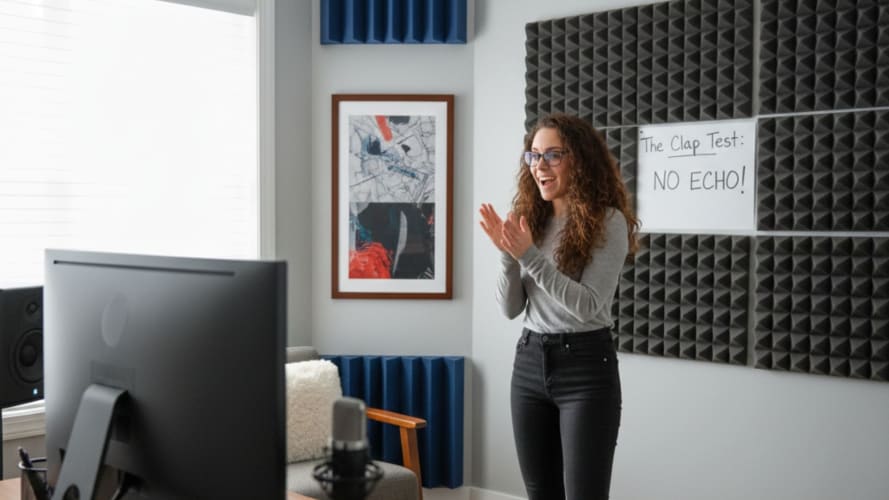
Before you even think about buying any acoustic foam, you need to understand where your room's acoustic problems lie. You can become an acoustic detective and find your room's problem spots in a mere 10 seconds with a simple test: the clap test.
Stand in the middle of your room, equidistant from the walls as much as possible, and clap your hands together, hard. What do you hear? Are you greeted by a quick, sharp, almost metallic "zing," a "bzzzt," or a rapid succession of echoes that seem to bounce back and forth multiple times? That is the tell-tale sign of "flutter echo."
You'll recognize this sound immediately if you've ever been in an empty room, an office with bare walls and glass, or a minimalist home studio setup. These echoes are the enemy of good sound. They smear transients, blur dialogue, and make instruments sound less defined. The primary culprits behind this phenomenon are flat, parallel walls. Sound waves bounce rapidly between these unadorned surfaces, creating that harsh, undesirable ringing effect. These reflective surfaces are your targets for acoustic treatment. By identifying these areas, you can strategically place your sound-absorbing materials to achieve the greatest impact.
So, how does acoustic foam work its magic? At its core, it’s a meticulously designed trap for sound waves. Understanding this mechanism helps clarify why different types of sound-absorbing materials are effective for different frequency ranges.
Imagine short, fast sound waves – these are the high frequencies responsible for the crispness of your voice, the shimmer of cymbals, or the sibilant "S" sounds in speech. These nimble waves bounce off hard, flat surfaces with ease, creating that rapid-fire flutter echo you heard in your clap test.
This is where acoustic foam excels. The material itself isn't a solid, impenetrable barrier. Instead, it's crafted with an open-cell structure, making it highly porous. When a high-frequency sound wave hits the foam, it doesn't just reflect away. Instead, it dives into this intricate, microscopic maze of fibers and air pockets. As the wave travels deeper into the foam, it's forced to bounce around repeatedly, colliding with the internal structure. With each collision and change of direction, the sound wave loses a tiny bit of its energy. Essentially, the sound wave goes in, gets tangled, loses its power, and doesn't come back out as an audible reflection. This absorption process is why what is acoustic foam is so effective at taming echoes and improving clarity.
Now, let's consider the other end of the spectrum: low frequencies. These are the long, powerful waves responsible for the deep rumble of bass guitars, kick drums, or the resonant "boominess" in certain voices. These waves are significantly larger and carry much more energy than their high-frequency counterparts.
Standard acoustic foam, while excellent for high and mid-range absorption, is simply too thin and lacks the necessary size and density to effectively "trap" or dissipate these powerful low-frequency waves. They will, for the most part, pass right through typical foam panels, continuing to cause problems like muddy bass or an overwhelming sense of "boominess" in your room.
To control bass frequencies, you need entirely different sound-absorbing materials: much thicker, denser products specifically designed for this purpose, often referred to as "bass traps." These are typically large, triangular, or cylindrical panels placed strategically in the corners of a room, where bass frequencies tend to accumulate. While bass traps are crucial for professional-level acoustic treatment, this particular guide is focused on understanding and utilizing standard acoustic foam for the more common mid and high-frequency echo issues that plague most untreated rooms.
Navigating the world of acoustic foam can be bewildering. With countless shapes, sizes, and colors available, it's easy to get sidetracked by aesthetics. But when it comes to performance, only a few factors truly make a significant difference in how effectively the foam tames your room. Understanding these will help you choose the right acoustic foam for your needs, whether for residential soundproofing or even lighter commercial soundproofing applications.
The thickness of the acoustic foam is arguably the most crucial specification because it dictates the lowest frequency it can effectively absorb. Thicker foam can absorb a broader range of frequencies, reaching lower into the mid-range.
1" Foam: This thinner option is primarily effective at absorbing mid to high frequencies. It’s good for subtle tweaks, helping to tame minor "hiss" or very high-pitched reflections. However, it won't do much for general room echo or muddy mid-range issues. This is rarely a recommended starting point for significant improvements.
2" Foam: This is the all-around workhorse and the gold standard for general acoustic treatment. 2-inch foam panels offer excellent absorption across low-medium, medium, and high frequencies. This thickness provides a fantastic balance of performance and affordability, making it the best starting point for most applications, including a home studio, an office where you take video calls, a dedicated home theater, or even just a living room where you want clearer dialogue. When considering "how thick should acoustic foam be," 2" is almost always the answer for general purposes.
3"+ Foam: As you move to 3 inches or thicker, the foam can begin to absorb some of the "upper-bass" or "boominess" in a voice or instrument, providing a more robust and full-range absorption. While not a true bass trap, thicker foam contributes significantly to a more balanced acoustic environment, especially in rooms where voices are paramount.
When you look at different sound-absorbing materials, you'll notice various surface patterns: wedge, pyramid, egg crate, or even flat. Does the shape truly matter for acoustic performance?
Mostly, it's an aesthetic choice. A "wedge" or "pyramid" profile does create slightly more surface area compared to a completely flat panel of the same overall thickness. This increased surface area can make the panel marginally more efficient at absorbing sound waves from different angles, as there are more immediate points for the sound to interact with the foam.
However, the difference in NRC (Noise Reduction Coefficient) between a 2" thick wedge and a 2" thick pyramid or even a 2" thick flat panel (assuming the same material density) is often minimal and typically imperceptible in a real-world listening environment. For example, in the "wedge vs pyramid foam" debate, the performance difference is usually negligible compared to the impact of the foam's thickness and material. Therefore, choose the profile that you find most visually appealing or that best fits the aesthetic of your room. Don't overthink this aspect.
This is where you absolutely cannot compromise. The material composition of your acoustic foam is critical for both performance and, more importantly, safety.
Do NOT use cheap packing foam: This is a crucial warning. Many beginners, trying to save money, might be tempted to use foam intended for packaging or other non-acoustic purposes. This is a massive mistake. Packing foam is typically not engineered for acoustic absorption and, more critically, it is often a severe fire hazard. It can ignite rapidly and produce toxic fumes. Using it in any occupied space is incredibly dangerous. Always verify that any sound-absorbing materials you purchase are specifically designed and rated for acoustic treatment.
Melamine Foam (The Pro Choice): This is the gold standard for acoustic treatment, particularly where safety is a paramount concern. Melamine foam possesses a Class A Fire Rating, which is the highest possible fire safety classification. This makes it the only acceptable choice for commercial soundproofing applications, public buildings, schools, offices, and any safety-conscious residential setting where fire safety is a priority. Beyond its safety, melamine foam is also an exceptional acoustic performer. It's rigid, lightweight, and incredibly effective at absorbing sound across a broad frequency range. Our FireFlex panels are a perfect example of high-performance, Class A fire-rated melamine acoustic foam, offering superior safety and excellent acoustics for any environment. This is often the answer to "Class A fire rated acoustic foam."
Polyester/Polyurethane (The Studio Choice): This is the classic "studio foam" that most people recognize. It's a highly effective and flexible material, renowned for its strong absorptive properties. While it doesn't typically achieve a Class A fire rating without special additives, it is generally treated to meet specific fire retardancy standards suitable for home studios and personal use (always check the product's fire rating before purchase, especially if you have specific safety requirements). Our Sonex panels use this type of foam in patented, high-performance shapes that maximize its acoustic benefits, making it an excellent choice for dedicated home studios where sound quality is paramount. When considering "melamine foam vs polyurethane foam," it often comes down to budget and strict fire rating requirements.
You don't need to be a certified acoustician, nor do you need to spend a fortune to achieve vastly improved sound in your room. By understanding a few fundamental principles, you're already well on your way to transforming your listening or recording environment.
The most crucial takeaway is this: acoustic foam absorbs echo; it does not block noise. This distinction is vital for setting realistic expectations and choosing the right soundproofing products for your specific needs. If you're struggling with flutter echo, muddied dialogue, or an overall lack of clarity, then acoustic foam is your go-to solution.
Start your journey by becoming an acoustic detective and doing the simple "clap test." This quick assessment will reveal the worst offenders – those flat, parallel surfaces that are causing your room's harsh reflections. Once you've identified your problem areas, choosing your foam is straightforward, focusing on two simple, yet critical factors:
Thickness: For general absorption and the most noticeable improvements, 2-inch thick foam is a fantastic starting point. It offers the best balance of broad-range absorption and cost-effectiveness for most home and small studio applications. For even deeper mid-range control, consider 3-inch or thicker options. When asking "how thick should acoustic foam be," remember 2" is your best bet for versatility.
Fire Rating: This is non-negotiable for safety. If you're treating a commercial space, a school, or simply want the absolute safest option for your home, always opt for Melamine foam with a Class A Fire Rating, like our FireFlex panels. For home studios, ensure any polyester/polyurethane foam you choose meets relevant fire retardancy standards.
With just a few strategically placed panels on your main reflection points – the areas where sound bounces directly from your speakers to your ears – you can eliminate that harsh flutter echo and finally hear your sound with the clarity and precision it deserves. Whether it's for improved music listening, clearer movie dialogue, or professional-sounding vocal recordings, you can achieve a remarkable transformation in your room in just an afternoon. Explore our range of sound-absorbing materials at SoundAway and discover the difference that proper acoustic treatment can make!