
We spend thousands of dollars on ergonomic chairs, organic linen sheets, high-end water filtration, and air purifiers that promise to scrub every invisible toxin from our environment. We track our sleep cycles with rings and our heart rate variability with watches. But there is one invisible pollutant most of us ignore until our stress levels are red-lining, our sleep is fractured, and our focus is shattered: Noise.
For decades, soundproofing was relegated to the "gritty construction chore" category. It was something you did with messy glues and heavy drywall because you had a loud neighbor who played the drums or because you were building a dedicated home theater in the basement. It was technical, industrial, and hidden.
But at SoundAway, we are leading a movement to rebrand silence. Silence isn't just the absence of noise; it is a functional state of being. In the modern world, silence is a nutrient for the brain. We’re shifting the narrative from "blocking out the world" to "reclaiming your mental space."
Welcome to the "Quiet Home" wellness trend. It’s time to stop thinking about soundproofing products as industrial fixes and start seeing them as the ultimate upgrade for your mental health and sanctuary. Contact us today.
Imagine walking through your front door after a chaotic day in the city or a long commute. Usually, the transition from "outside" to "inside" is a slow bleed of stress. But in a Quiet Home, you feel an immediate, physical "drop" in tension the moment the door clicks shut.
In this environment, there is no low-frequency hum from the refrigerator vibrating through the floorboards. There is no muffled thud of footsteps from the apartment above that triggers a subconscious "alert" response. There is no distant siren bleeding through the glass to interrupt your train of thought.
In our hyper-connected, hyper-audible era, peace and quiet are a luxury commodity. We have optimized our homes for sight (interior design) and smell (aromatherapy), but we have historically neglected our ears. The "Quiet Home" trend treats "acoustic comfort" with the same reverence as a clean diet or a consistent sleep schedule. By integrating high-quality soundproofing materials, you aren't just fixing a room; you are lowering your baseline cortisol and giving your brain the "white space" it needs to recover.
To understand why residential soundproofing is a wellness necessity, we have to look at how the human brain processes sound. Evolutionarily, our ears are our "always-on" surveillance system. Even when you are deep in sleep, your brain is monitoring your environment for changes in frequency or volume.
When your brain detects a sharp or intrusive noise—a barking dog, a slamming car door, or a heavy footstep—it triggers the amygdala. This sends a distress signal to the hypothalamus, which then prompts the adrenal glands to release cortisol and adrenaline.
In a modern, poorly insulated home, this happens dozens, if not hundreds, of times a day. You might think you’ve "tuned it out," but your nervous system hasn't. This chronic low-level noise keeps your body in a state of low-grade "fight or flight," leading to increased anxiety, higher blood pressure, and a weakened immune system over time.
In the era of remote work, the home is no longer just a place to sleep; it’s a high-performance environment. However, noise is the ultimate productivity killer. Research suggests it can take an average of 23 minutes to regain a state of "flow" after being interrupted by a distracting noise.
By using sound-absorbing materials to absorb the echoes of a busy household—the clacking of a keyboard, the hum of a dishwasher, or a child playing in the next room—you aren't just making your office quieter. You are literally expanding your cognitive bandwidth.
One of the biggest hurdles to adopting home soundproofing methods in the past was the "industrial look." Homeowners feared that to get a quiet room, they would have to compromise their interior design. They imagined ugly grey foam pyramids or thick, unsightly blankets hung over windows.
The "Quiet Home" trend flips this on its head. At SoundAway, we believe that home soundproofing materials should enhance your aesthetic, not hide it. Whether your style is ultra-minimalist, mid-century modern, or industrial chic, silence can—and should—be beautiful.
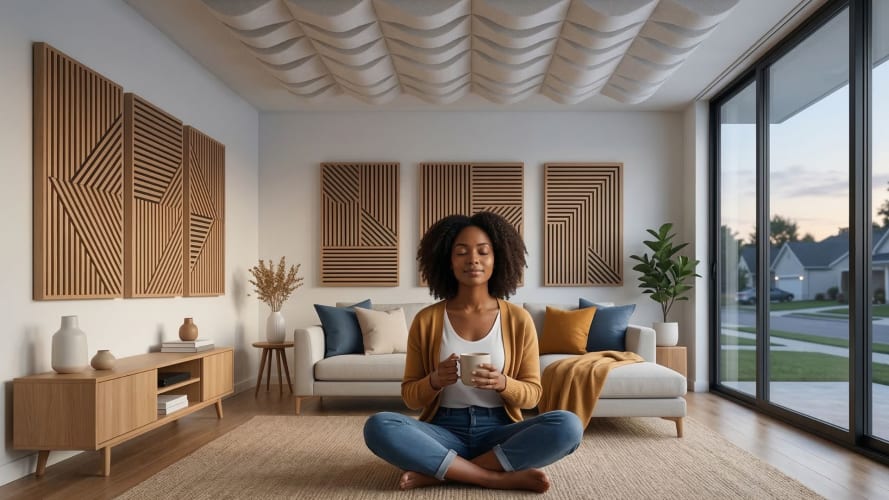
Whisperwave Clouds: For those living in industrial lofts or homes with vaulted ceilings, "echo" is the enemy. Whisperwave Clouds are sculptural, undulating elements suspended from the ceiling. They break up sound waves before they can bounce, acting as both a functional tool and a bold architectural statement. You can also consider Rondo Baffles that come in many premium colors.
EchoDrop Pepp Panels: These materials offer a distinct pebble-like finish and would fit well in a garage workspace for a modern look.
To truly achieve a wellness-focused home, you have to look at the anatomy of your space. Sound is energy, and energy travels through the path of least resistance. Most noise issues in modern construction stem from "flanking paths"—small gaps and thin materials that let sound leak through like water through a sieve.
If you live in a multi-story home, a condo, or a townhome, impact noise is likely your primary stressor. The sound of a chair dragging across a floor or a child running in the room above is "structure-borne noise."
This is where the best soundproof underlayment becomes your most valuable player. By installing a high-performing underlayment (like recycled rubber or specialized foam) beneath your hardwood, tile,carpet, or luxury vinyl plank, you "decouple" the floor surface from the building’s structure. It acts as a shock absorber for the entire house.
Effective home soundproofing methods generally rely on four principles: Mass, Decoupling, Absorption, and Damping.
Mass: Using heavy soundproofing products like Mass Loaded Vinyl (MLV) adds density to walls, making it harder for sound waves to push through.
Damping: This involves using materials like Green Glue Damping Compound between layers of drywall. It converts sound energy (vibration) into microscopic amounts of heat, effectively "killing" the sound before it reaches your ears.
The open-concept floor plan has dominated residential architecture for two decades. While it’s great for sightlines and light, it is an acoustic nightmare. Hard surfaces—polished concrete, floor-to-ceiling glass, and stone countertops—reflect sound endlessly, creating a "cocktail party effect" where even a quiet conversation feels loud.
In a wellness-focused home, we use residential soundproofing to create "Acoustic Zones":
The Deep Work Zone: A home office treated with acoustic door seals and wall panels to ensure total privacy for calls and deep focus for projects.
The Sleep Sanctuary: The bedroom should be the quietest place in the house. This often requires looking at the walls and ceiling. Isolation clips help to prevent impact noise from above, and thick floor rugs are effective for sound absorption and offer better acoustics
The Social Hub: Using sound-absorbing materials in the kitchen and dining area, such as Sonex Rondo Baffles ensures that the "clatter" of life stays contained, allowing for better communication without having to raise your voice.
When you begin your journey toward a Quiet Home, the sheer volume of soundproofing products can be overwhelming. Here is a breakdown of how to choose based on your specific needs:
At SoundAway, we’ve noticed a fundamental shift in why people reach out to us. A decade ago, the questions were purely technical: "What is the STC rating of this material?" or "Which glue should I buy for this specific drywall?"
Today, the conversation is different. You aren't just looking for hardware; you’re looking for a lifestyle. You’re asking, "How can I make my home a sanctuary?"
We have evolved alongside this trend. We provide the professional-grade soundproofing materials that major recording studios and high-end hotels use, but we’ve curated them for the homeowner who values design, health, and tranquility. We believe that silence is a fundamental pillar of a healthy home, right alongside clean air and natural light.
Beyond the immediate stress relief, investing in home soundproofing materials is a savvy financial move. As more people move to remote or hybrid work models, "acoustic privacy" is becoming a major selling point in real estate. A home that feels "solid" and "quiet" carries a premium that a "loud" house simply cannot match.
More importantly, you are investing in your future self. You are investing in:
Better Sleep: Allowing your body to reach the REM and deep sleep stages without interruption.
Reduced Anxiety: Lowering the daily "sensory load" on your brain.
Better Relationships: When you aren't constantly shushing family members or fighting for quiet, the home becomes a place of connection rather than conflict.
The "Quiet Home" wellness trend isn't a passing fad—it's a necessary response to an increasingly noisy, digital, and intrusive world. It is the final frontier of the wellness movement.
When you choose to integrate soundproofing products into your home, you are making a profound statement about your priorities. You are choosing to protect your focus, your rest, and your peace. You are turning your house into a true sanctuary.
Are you ready to stop "dealing with" the noise and start designing your silence? Get in touch with our consultants today.